






Tomato hornworms are one of the most common pests in the tomato garden. They’re rather creepy pests but harmless to you.

Hornworms will, however, do big damage to your tomato garden if left unchecked.
Jump to:
- Two Types, But Not Worth Splitting Hairs Over
- Rather Hard to Find for Such a Large Insect Pest
- 1. Poop!
- 2. Eaten Leaves
- 3. Eaten Fruit
- 4. Skeletonized Leaves and Stems
- 5. Sun Scalded Tomatoes
- 6. Hawkmoths in the Yard or Garden
- 7. Hear Them Crunching!
- 8. See Them!
- Follow the Trail Back to Find Hornworms (And a Few Other Location Tips & Tricks)
- You May Find Signs on Other Garden Plants, Too
Two Types, But Not Worth Splitting Hairs Over
There are two types of hornworms that live in tomato gardens. One is the actual tomato hornworm, and the other is the tobacco hornworm.
There’s little difference between the two. In appearance, they’re almost the same, except that one has an extra set of white slash markings on its sides and a different color thorny spike on the end of its tail.
For all intents and purposes, though, they’re the same pest, dealt with the same way, and unless you go to great pains to decipher the difference, one will look pretty much the same as the other.
This is to say, when we talk about hornworms in tomatoes or the actual tomato hornworm, we’re talking about both types. You can use the term interchangeably for the sake of this discussion.
Rather Hard to Find for Such a Large Insect Pest

Tomato hornworms grow to be about four inches in length, with plenty of girth to support them. They are very large insect larva.
They’re literally about the size of an adult human’s finger. So, you’d think they’d be easy to find.
Alas, they are not. Hornworms can be very elusive in a tomato patch. They blend in exceedingly well. Even when you are sure they are there, it can be hard to find them amongst the foliage.
It gets easier to locate them as the damage increases, which it will do quickly. Hornworms can eat up to four times their growing body weight every day!
Letting them defoliate your tomatoes to find them isn’t a very good strategy, though, and even then, locating hornworms can be difficult!
The best thing you can do to limit the damage from hornworms in your tomato patch is to keep a close watch out for the signs hornworms leave behind, and then use a few useful tricks to find the offenders – while you still have good tomatoes to protect!
To help you know how to look for hornworms in your tomatoes, here are eight of the most common and most obvious signs tomato hornworms leave behind:
1. Poop!

This may sound exceedingly odd, but poop is often the first sign you will see when hornworms are present.
The size of the droppings will be relative to the size of the hornworms (which are actually caterpillars that are eating and growing until they pupate, as all caterpillars do).
When the caterpillars are small, the droppings will look like dark pebbles of soil. As they grow, you’ll see they are small cylinder-shaped droppings, round with flat ends.
When the droppings are fresh, they are a dark, bright green, like concentrated leaf matter. They darken as they dry out.
This may also sound odd to say but focus most heavily on the greener pellets. Those will tell you where the caterpillars were feeding most recently, and it is usually near those where you are most likely to find the caterpillars.
2. Eaten Leaves
If you see tomato leaves with crisp, rounded edges and deep cuts in them, start suspecting hornworms.
Leaves will usually be eaten from the outside edges in.
You may also see leaves with large holes in them – big bites taken by the caterpillars.
You may see leaves with holes starting from the center rib of the leaf if the caterpillar traveled in that way.
3. Eaten Fruit

Hornworms will take big bites out of tomato fruits, too. They’ll usually do this in the green, unripe fruit, but they will sometimes eat ripening tomatoes, too.
It may be just a bite or a few, or they may eat an entire tomato – especially small tomatoes. You might also find brown scabs and scars on your tomatoes left from where a hornworm took a few bites and then moved on. Those bites will often heal over to become scabby scars.
4. Skeletonized Leaves and Stems
This is a tell-tale sign of hornworms that have been around for a while.
If you have sections of plants – or entire plants – that are chewed down to just a skeleton consisting of the plant’s stem and leaf stems and ribs, it’s almost certainly hornworms. Few other things will eat a tomato plant so completely.
5. Sun Scalded Tomatoes
Hornworms are not the direct cause of sun scald on tomatoes. A lack of protective foliage is.
This can come from over pruning, but it can easily be the result of hornworms eating away the leaf canopy, leaving fruit exposed to direct sunlight.
If you’re finding scalded fruit and you don’t think you’re the cause of the defoliation, look for who might have stripped your leaves away.
6. Hawkmoths in the Yard or Garden

Sphinx moths, more commonly called hawk moths, are the adult version of the hornworm. They are the adults that lay the hornworm's eggs. After they feed and pupate, the caterpillars will become the next generation of hawk moths.
There are many types of sphinx moths, but the two that feed on tomatoes are the Tobacco Hawk Moth (Manduca sexta) and the Five-spotted Hawk Moth (Manduca quinquemaculata).
If you see large moths flying around with a wingspan of up to five inches, they may be hawk moths. And they may be laying hornworm eggs in your tomatoes!
Even if you’re not sure if the particular sphinx moth you’re seeing is a tomato or tobacco sphinx (or hawk) moth – because there are many types of hawk or sphinx moths – start looking through your tomato patch anyway.
The timing will be the same for most of these, and knowing any are around indicates that the moths that lay in tomatoes could be around, too.
Hawkmoths can be a bit elusive, though, because they are nocturnal. They aren’t really active during the day. You may find them around outdoor lights at night or in the morning.
That said, while the caterpillars are highly destructive and a big problem for home gardeners, the hawk moths are not destructive of the plants themselves. They are also fair pollinators – not as good as bees, but important for some night-blooming plants because they work at night.
Some people prefer not to kill hornworms if they can help it and may relocate them or leave a single sacrificial tomato plant that they move them to instead. This way, they can live to become pollinating moths.
7. Hear Them Crunching!
Yes. You can actually hear hornworms crunching your tomato leaves. Especially when they get big. Especially if there are several of them.
If you walk through your tomato patch and hear a strange, rubbery crunching sound, sort of like a squeak, look around for other hornworm signs.
And follow your ears!
8. See Them!
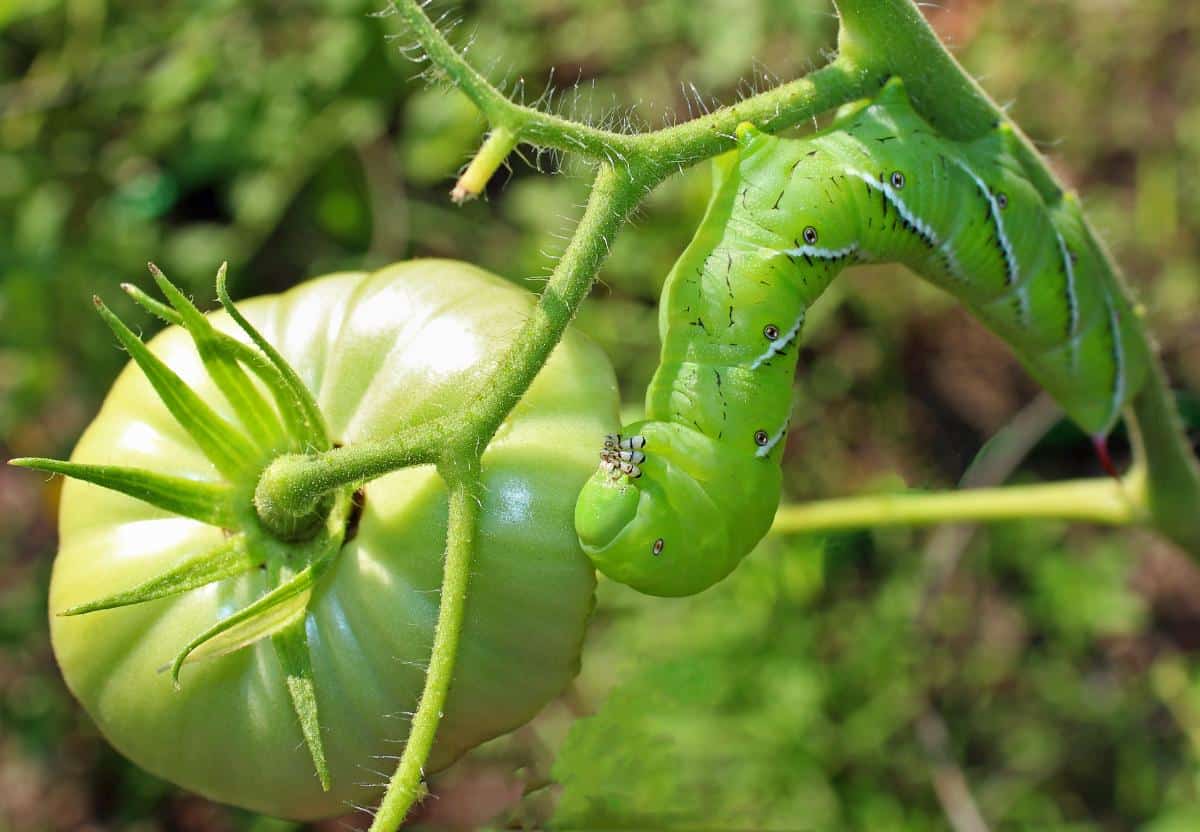
Finally, if you see a nearly fluorescent green caterpillar with a spiky, thorn-like “horn” on its tail end and white diagonal stripes on its sides, you’re seeing a hornworm.
They’re harder to see when they’re small and they hide well, but as they grow, they’re easy to see with the naked eye because they get up to around four inches long and about a half inch thick.
...That is if you can see them beyond their camouflage.
Follow the Trail Back to Find Hornworms (And a Few Other Location Tips & Tricks)

Once you see signs of hornworm infestation, you’ll want to take quick action. A single hornworm can completely defoliate a tomato plant, depending on its size and how long it has been feeding; also depending on the variety and size of the plant (but even on the biggest indeterminate tomatoes, hornworms will do a lot of damage!).
The best thing to do is to start where you see the caterpillar sign, then work from there to locate and deal with the hornworm.
Here are some tips and tricks that will help:
- Follow the trail of old, dried, dark feces to fresher droppings
- Follow small to large because the droppings will increase in size as the caterpillar grows – which it does very quickly
- Do also keep in mind that you can have several hornworms on the same plant
- Hornworms may also be at different stages of growth, and therefore, there can be different sizes of worms on the same plant
- If you see different sizes of fresh, green droppings, that’s a sign that you should be looking for both small and large caterpillars
- Look under leaves and foliage
- Look for the caterpillars stretched out along the ribs of leaves and stems
- Scan slowly – the green body of the caterpillar is about the same color as the stems and leaves of the tomato plant
- Start where you see the freshest signs of caterpillar droppings or fresh plant damage
- Survey that spot, then start following it outward up, down, and under leaves and on stems of the plant until you find the offender eating your tomato
- It often seems as though you were staring right at a caterpillar the whole time before you finally spot it
- One of the best ways to find hornworms is to go out in the dark, either early in the morning or after sundown at night, and shine a UV blacklight on them
- Under a blacklight, hornworms will seem to glow a whitish, green, and sometimes purple hue
- There are several things you can use to control hornworms
- The best way to control tomato hornworms is really to pull them off and either feed them to insect eaters (ducks love them, and chickens often enjoy the treat) or drop them in a jar of very soapy water, which will kill them (just dish soap and water will do)
- Hornworms won’t bite or hurt you, but they have strong foot attachments that feel weird so you might prefer to wear gloves when picking them off and handling them
There is one final thing worth noting. If you find hornworms with cylinder-shaped, white eggs poking up in rows out of their backs, leave them and don’t kill them.
These caterpillars have been parasitized by a helpful parasitic wasp. They will die soon and when they do, there will be a new generation of wasps to help you naturally fight and control hornworms in your tomato garden.
You May Find Signs on Other Garden Plants, Too

This is worth knowing for the sake of your tomatoes and for the other valued plants in your garden.
Tomatoes are the favorite food of hornworms, but they like other plants, too. Namely, solanaceous plants; plants in the nightshade family.
In addition to tomatoes, hornworms may infest peppers, eggplant, potatoes, tobacco, and some weeds including nightshade and horse nettle.
It’s a good idea to watch keep these (and other) weeds out of your garden to reduce the attraction for the hawkmoths that lay hornworm eggs.
It is also a good idea to keep an eye out for these same hornworm signs on these other types of plants for the protection of these other crops and your tomatoes, too.
If you see any of these signs of tomato hornworms, the next thing to do is to take action. Don’t delay – damage is swift and exponential as they grow.
Find ways to deal with tomato hornworms here, along with products that you can use to safely (organically) kill them.


