


Epsom salt is a popular garden aid. While it is true that the benefits of Epsom salt can be overstated, and not all gardens need or should have Epsom salt applied, there are several ways that Epsom salts can potentially boost your tomato plant health and your tomato yields, too.

Jump to:
What Does Epsom Salt Do In The Tomato Garden?
Primarily, Epsom salt is a source of magnesium and sulfur. It is, actually, magnesium sulfate, a type of beneficial salt. However, because it is a salt, you don’t want to use it indiscriminately all the time. Use Epsom salt strategically so you don’t overload your soil with salts, and you can see a great benefit from it.
Epsom salt has the advantage of being a targeted source of magnesium, especially, and yes, sulfur, too. It is very easy to use by putting a scoop in the hole when planting your tomatoes or top or side dressing plants as needed. It washes into the soil easily with water or rain.
Epsom salt can be applied as a foliar spray, too, in a low dilution. This can get magnesium and/or sulfur into or onto leaves quickly.
Buying and sourcing Epsom salt

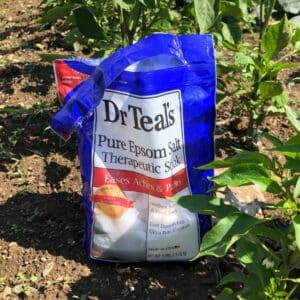
Another advantage of Epsom salt is that it is cheap and accessible. You can buy it in any grocery or department store. You can easily order it online, too.
One thing to look out for is Epsom salt products that have other things added to them. For example, many epsom salts that are sold in health and beauty aisles will have scents or essential oils in them (lavender is popular, because it promotes relaxation, and the salts are frequently used for rejuvenating baths or foot soaks).
While many of these essential oils probably won’t do harm in the tomato patch, they are unnecessary and unknown.
So, the bottom line is to buy plain Epsom salt without oils or other additives.
How Epsom Salts Help Tomato Plants

Both magnesium and sulfur are essential for tomato health and immune support. Both are minerals, and one thing that is known is that minerals are increasingly depleted in soils, especially in soils where monocropping has occurred, in commercial tomato and produce fields, or in places where the same fruit or vegetable has been grown over and over.
While we often use fertilizers to replenish soils, most fertilizers do not focus on minerals like these, so while nitrogen, phosphorus, and potassium are often replaced, minerals often are not.
Mineral depletion is probably less likely to occur in the home garden, at least not as quickly or as completely as it occurs in commercial farming. But it does happen.
Some soils just never had good levels of these minerals to begin with. So even if you are gardening in new ground, there’s a possibility that minerals like magnesium and sulfur are low. Sandy soils are known for being low in magnesium because it gets washed out, and there is no organic matter there to hold it in.
Signs of magnesium deficiency in tomatoes

A soil test can reveal if you have low levels of sulfur or magnesium, but if you don’t want to go through having your soil tested, you can also observe your plants for the symptoms of deficiency.
There are some tell-tale symptoms of magnesium deficiency. Leaves that have bright green veins but yellowing of the leaf area are suffering from magnesium deficiency and are not producing chlorophyll. Leaves may also have a red, brown, or purplish tinge to them. These are plants that can benefit from an Epsom salt boost.
Or, some simple trial and error applying epsom salt usually won’t hurt if you don’t overdo it, and reversing the problem you’ve had is a good indicator that the epsom salt is helping.
One final thing to consider is that if your soil is low in minerals like magnesium, so is the food you’re growing in it. Mineral depletion is one of the reasons our commercial produce is not as nutrient-dense as it used to be!
So, your Epsom salts may not just be boosting your tomatoes -- it might be boosting you, too!
8 Ways Epsom Salt Helps Tomatoes

Here are eight of the best ways Epsom salt can potentially help your tomato garden:
1. Aids seed germination when used in planting holes (debated)
2. Boosts root growth
3. Boosts cell development
4. Supports photosynthesis (Magnesium is essential for photosynthesis, and Epsom salt provides that. Thus, it supports photosynthesis, allowing tomato plants to convert light energy into usable chemical energy in the form of usable sugars.)
5. Minimizes blossom drop

6. Supports blossom and fruit development, growing healthier, larger tomatoes
7. Boosts plant growth (Supports plant growth by supporting cellular development and supporting the pathway of energy creation. By giving your tomatoes what they need for good cellular structure and energy, you’re giving your tomatoes what they need to grow bigger and stronger.)
8. Possibly helpful to prevent blossom end rot. (Epsom salt will not directly prevent blossom end rot; blossom end rot is caused by a calcium deficiency, often caused by overwatering, and a balance of magnesium and calcium is important for the plants to be able to uptake and distribute calcium. Epsom salt use can also potentially prevent blossom end rot because it supports strong roots and plants and therefore a healthy vascular and cellular system, which allows the plant to utilize and deliver calcium. However, too much magnesium can block calcium absorption. This is why judicious use is called for.)
How Helpful Are Epsom Salt Applications for Tomatoes?

Truth be told, there is some debate as to whether all of the above really happen when you use Epsom salt on your tomatoes. Experts seem to disagree. Often, the result is that the benefits are somewhere in the middle.
Or, more accurately, sometimes the benefits are real, but unnecessary if you don’t have a depletion of magnesium or sulfur to begin with. So some people are not enjoying these results from Epsom salt, because they didn’t have the problem they thought they had to begin with.
Sources do agree that magnesium and sulfur support strong tomato structure and health on the cellular levels, and boost photosynthesis and tomato energy production. That alone is a good reason to use (but not abuse) Epsom salt on tomatoes. Because with good cell health, structure, and energy comes good immune support and optimal health and function of the plant, so it can better defend against what else might come its way.