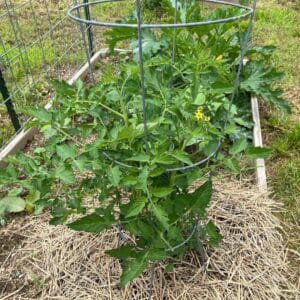
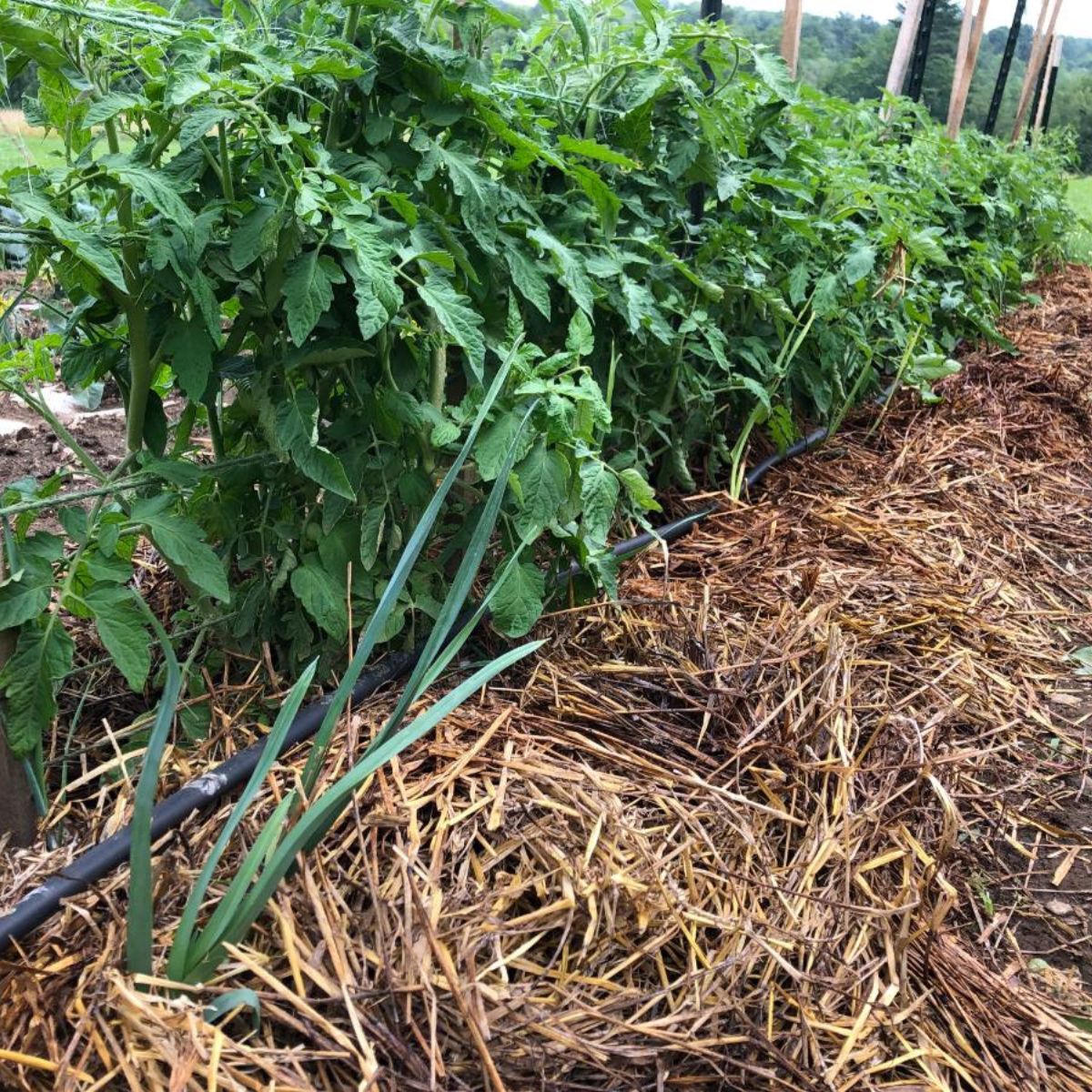




Did you know? You can fix thin, spindly, lanky, or leggy tomato plants when you plant them in the garden.

Planting time presents the perfect opportunity to correct height and strength problems in tomato transplants. It’s a simple fix!
Jump to:
- The Strongest Start for Tomatoes is Indoors, But Legginess is Common
- Legginess is Common in Indoor Grown Tomatoes
- Overgrown or Too-Tall Tomatoes Can Be Fixed, Too
- The Problem with Leggy, Thin, Too Tall Tomato Transplants
- How to Plant to Fix Tall, Leggy Tomatoes
- Why this works
- Wind and breezes will also help to strengthen stems
- Planting sideways works well, too
The Strongest Start for Tomatoes is Indoors, But Legginess is Common
Tomatoes are usually started indoors from seed (whether by you or at a local greenhouse or nursery). Tomatoes are frost-sensitive, so in order for most gardeners to get a long enough season to grow them, they need to be started indoors in a warm, protected environment. Then, when the conditions are right and the danger of frost has passed, the tomatoes are hardened off and then transplanted into the garden or outdoor beds.
Even if you live where frost isn’t a major issue, starting and planting from transplants has a lot of benefits. Mainly, having large enough plants that don’t get lost or overgrown as seedlings, but also having the option to plant out only the best and strongest plants, without worrying about whether you’ll waste time on seeds that don’t germinate.
Legginess is Common in Indoor Grown Tomatoes

One of the most common problems with tomatoes that are started indoors is that they often become “leggy”. This is when tomato stems are thinner than ideal, or when they have long, thin stems with only a few sets of leaves.
When legginess happens, we have just a few opportunities to correct it.
One is when we’re potting up our seedlings or transplants.
The other -- and final -- opportunity is when we plant the tomatoes outside in the garden (or into containers or raised garden beds).
Even though legginess is not ideal, if you’ve gotten your leggy tomato plants to transplant size (or perhaps they came that way from the garden center), odds are that if you correct the problem when planting, the plants will thrive and produce well.
Overgrown or Too-Tall Tomatoes Can Be Fixed, Too
Another issue may not be legginess so much as it may just be tomatoes that grew overly tall and spindly, with thinner-than-optimal stems.
This often happens when tomatoes grow faster than expected in their cell packs or seedling pots. It happens a lot when the plants are crowded together in the greenhouse or any time tomatoes have to compete or reach for light.
Tall, spindly seedlings also happen when tomato transplants are just getting older, and they’ve spent too much time living in cell packs or seedling pots. This is common by planting time. These are often plants that really should have been potted up one more time, but it got too close to planting time and wasn’t worth the extra step or extra materials and soil.
What results are tomatoes that are very tall, with only two or three sets of leaves, and thin stems.
The Problem with Leggy, Thin, Too Tall Tomato Transplants

The only real problem with tomato transplants that are too tall, thin, leggy, or lanky is that they won’t be the best or strongest base for the rest of the plant as it grows. Often, when transplants like these are set out, they are broken by wind or rain before they can toughen up.
If all or most of the leaves on the young plants get broken, the transplant won’t be able to recover.
To stop this from happening, you want to shorten up these tall transplants so that they are not quite so top heavy, and aren’t as vulnerable to wind, wilting, and breakage outdoors.
How to Plant to Fix Tall, Leggy Tomatoes

Fortunately, the fix for too tall, thin, and lanky tomato transplants is super simple.
All you have to do is plant your tomatoes deeply.

- Strip any leaves from the low portions of the tomato; this allows for these areas to convert to root growth.
- Try to leave at least two sets of true leaves on the tomato to live above the ground, and fuel the plant through photosynthesis.
- Your goal should be to have about 6 to 8 inches of exposed plant above the soil line. You may have to make a judgment call, depending on the age, height, and thinness of the tomato’s stem.
- Now, dig a hole deep enough to fit the root ball and the extra stem length.

- Place the root ball all the way to the bottom of the hole, and then fill the hole in with the extra soil up to the soil line.
- Tamp the soil down to firm the plant in the hole.
When you are done, the plant should stand firmly on its own. It should not be top-heavy. If you think the tomato is still too top-heavy and looks like it may bend or break on its own, you can plant it deeper. Just make sure there are at least two sets of leaves above the ground to photosynthesize and produce energy for the plant.
It is also best to set any tomato stakes, cages, fences, or support systems in place when you plant your tomatoes. That way, you can start tying up your growing tomato in a week or two, and you won’t damage any new roots (which grow quickly) by driving stakes into the ground later on.
Why this works

Tomato plants will grow roots along any part of the stem that is planted in soil. These are called “adventitious roots”. They grow from follicles in the skin of the stem. When the stem senses contact with soil, it will turn the cell structure to root formation.
Sometimes, we even see these adventitious roots above the ground, growing on exposed portions of the stem. This happens in high humid conditions. It’s nothing to worry about, and can just be ignored if it happens above ground. If the roots are close enough to the soil, they may even reach out and root in.
If these “extra roots” form along the exposed stem before you plant the tomato plants in the garden, you can sink these down into the soil, and they will become new plant roots, providing extra anchoring and water and nutrient access.
Wind and breezes will also help to strengthen stems
Stimulation triggers tomatoes to grow thicker stems. Indoors, we can stimulate thicker stem growth by regularly running our hands over the tops of the plants or by using a fan. This helps a lot and sets the plants up well for when they’re living outside (hardening off takes care of the rest).
The stronger and more variable winds and breezes that your tomatoes experience outside will help to strengthen the exposed stems even further. But when your tomatoes are very tall or too thin and spindly, it’s best to plant them deeply, as outlined here, to reduce the height, which reduces their exposure to wind, and lowers the chance of them breaking before they can build themselves up.
Planting sideways works well, too

Another variation on this technique is planting your tomatoes sideways or at an angle.
This is the same basic concept, except instead of digging your hole straight down, you would dig it as a sideways trench or on an angle.
The tomato transplant gets the same benefits of reducing height and growing extra roots underground, but it also grows those roots along more area under the ground. Instead of one anchoring point in a straight line below the tomato, the anchoring happens along more surface area under the surface of the ground.
In either case, deep planting easily fixes the problem of tomato transplants that are too tall, and increases the overall root area. This results in more roots to bring up water and nutrients, and the ability to bring them up from further down in the soil (which can be quite helpful if conditions turn dry on you during the summer growing season).